
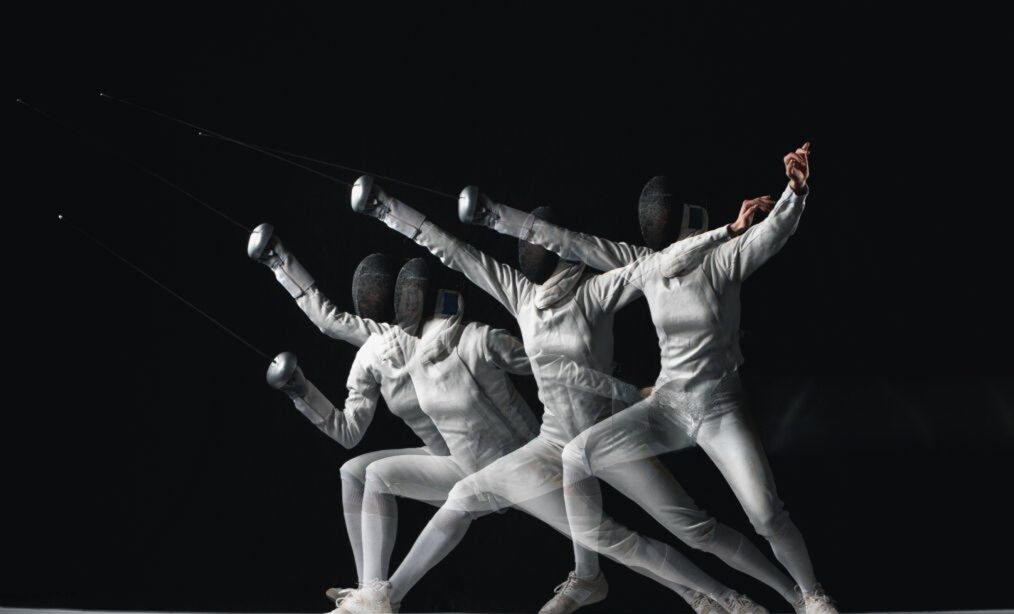
In fencing, victory is often decided in milliseconds.
Whether you are executing a sudden advance-lunge or parrying a rapid attack on the target area, raw physical speed alone is not enough. True fencing speed is a combination of visual perception, mental processing, and explosive physical execution.
If you want to move faster and react quicker on the strip, focus on these six actionable strategies and training drills to improve your speed and reaction time.
Reaction time VS movement speed
Improving your speed requires breaking down what happens between seeing an opponent’s action and landing a touch:
- Perception, decision & reaction time: The split-second it takes your brain to recognise a cue (e.g., an opening in high line, a sudden step forward) and select the correct counter-action.
- Movement execution time: The physical time it takes your body to contract muscles, drive off the back leg, and extend the blade.
Most fencers make the mistake of focusing entirely on physical sprint training while ignoring visual perception. Training your brain to process visual cues faster yields the biggest gains in effective speed.
3 drills to improve reaction time in epee fencing
To sharpen split-second decision-making, integrate these reaction drills into your regular footwork sessions:
1. Signal-change footwork drill
This drill forces you to transition from steady footwork to explosive movement without hesitating.
- Begin by partnering up with your teammate or epee fencing coach
- Advance and retreat maintaining distance
- On an audio cue (a clap) or visual cue (a hand flash), immediately change direction or launch a lunge
2. Glove drop drill
Next, try out this training, which trains visual tracking, drop-step mechanics, and hand-eye coordination under pressure.
- Have a partner stand two steps in front of you holding a glove at shoulder height
- Without warning, they drop the glove. Your goal is to lunge and catch or pin the glove before it hits the floor
3. Variable choice parries
Alternatively, this parry training reduces choice-reaction time by conditioning instant motor responses to specific cues.
- In a lesson or drill, have your coach attack randomly to two different lines (e.g., high inside vs. low outside)
- Practise making the correct parry-riposte without guessing in advance
Distance management also affects reaction time
The fastest fencers are not always the ones with the quickest muscle contractions.
Instead, they are often the ones with superior distance awareness.
Maintain the critical distance: By staying just outside your opponent’s direct attack range, you give yourself extra fractions of a second to evaluate their movement before reacting.
Read preparation movements: Pay attention to your opponent’s rhythm and small telltale signals (a lowering shoulder, a shift in weight, or a rhythmic footstep pattern). Recognizing a setup allows you to anticipate the attack before it is launched.
3 drills to improve your physical speed in fencing
However, fast reactions mean little if your body cannot translate the command instantly. Build explosive leg power and core stability with these key exercise types:
1. Plyometrics
Incorporate box jumps, broad jumps, and single-leg bounding to develop fast-twitch muscle fibers in the calves, quads, and glutes.
2. Deceleration & change-of-direction training
Fencing requires starting and stopping abruptly. Practise shuttle runs and lateral lunges to strengthen the joint stability needed for sudden changes of direction.
3. Core & posture control
A strong core prevents torso lean during lunges, allowing energy to transfer directly into forward velocity rather than wasted body movement.
Train smarter & move faster with DSFencing Club
Boosting your speed in fencing comes down to consistency in deliberate practice.
By combining fast-twitch physical conditioning with visual reaction drills and strong tactical spacing, you will start beating your opponent to the touch.
At DSFencing Club, we offer tailored fencing lessons for beginners looking to learn the fundamentals as well as structured sparring sessions where you can put your speed and tactics to the test against real opponents.
Improve your speed and reaction time to the next level to reach your full potential on the strip today. Ready to pick up the blade? Contact us now to learn more.
Frequently Asked Questions (FAQs) about improving speed & reaction time in fencing
1. Does fencing require fast reaction time?
Yes, but tactical anticipation matters more than raw speed. Fencing relies heavily on choice reaction time, which means reading an opponent’s intent, selecting the right response, and executing it.
While fast reflexes help, distance control and reading body language are what actually allow fencers to react in time.
2. What is the average reaction time of a fencer?
For simple visual signals, the average person reacts in 200–250 milliseconds, while trained fencers average around 170–190 milliseconds.
For complex combat situations, a fencer’s choice reaction time ranges from 300 to 400 milliseconds. Elite fencers seem faster because their brains recognise subtle movement cues early, reducing decision-making time.
3. Can you train to improve your reaction time in fencing?
Yes. While biological reflexes have a genetic limit, you can drastically sharpen your effective speed through targeted practice.
Repeating technical blade drills, mastering distance management, and doing explosive footwork exercises (like hops and stair sprints) train your brain and nervous system to process cues and execute attacks faster.