Key summary
- What is a fleche: Fleching is an all-in maneuver. Unlike the lunge, it has no recovery stance – you must commit your entire momentum forward, making it a high-risk, high-reward tool in your tactical kit.
- How to execute a fleche: It depends on the arm-first mechanic. Your extension must be nearly locked before your center of gravity shifts to prevent attacking in preparation, which is the most common beginner mistake that leads to being hit mid-run.
- The best fleche is a controlled fall: Fleche is not a jump. By shifting your weight until you break equilibrium, you use gravity to generate instant acceleration that is faster and lower-profile than a standard push-off.
- Missing a fleche (the passé): This is not an automatic defeat. By keeping your guard high to close the line, pathing closely past the opponent’s non-weapon shoulder, and sprinting until you are way out of distance, you can neutralise their riposte.
- Best time to set up & launch a fleche: During the opponent’s preparation or to break a static footwork rhythm. It forces the opponent to process a sudden change from a slow walk to a full sprint, bypassing their mental defense.
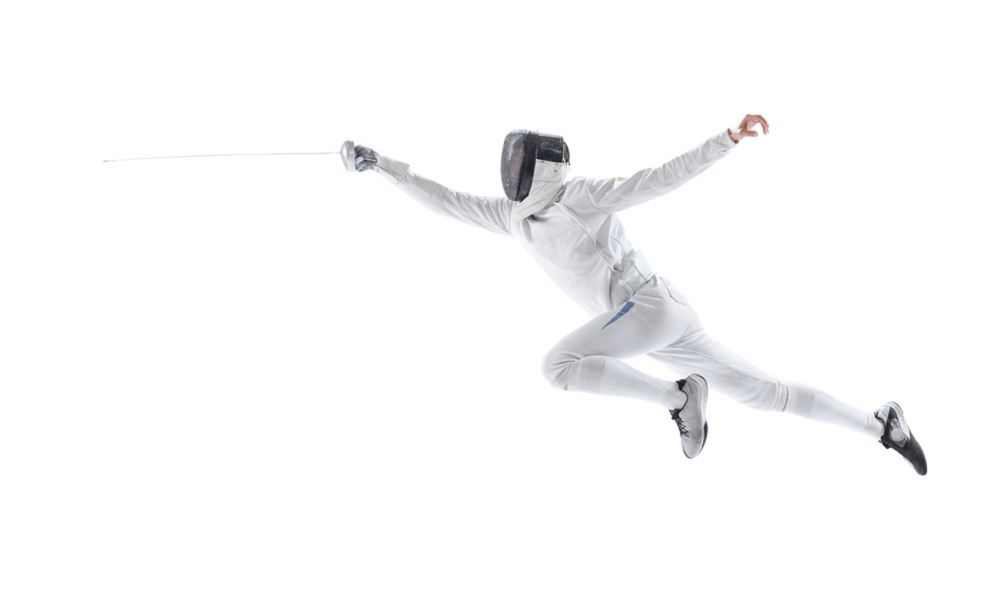
In the world of epee fencing, there is no movement more iconic, more polarising, or more exhilarating than the fleche. Derived from the French word for “arrow,” the fleche is exactly that: a sudden, airborne release of energy where the fencer literally runs past their opponent.
Unlike the lunge, which allows for a quick recovery to a defensive stance, the fleche is an all-in commitment. Once you cross that threshold of balance, there is no turning back. You either land the touch, or you are left completely exposed as you sprint past your adversary.
In this guide, we will break down the mechanics, mindset, and timing of the fleche to help you decide: to fleche, or not to fleche?
How to execute a fleche in fencing
To execute a successful fleche, you must understand that it is not a jump, but a fall. If you move upward, you lose time. If you move forward, you gain the point.
Step #1: Extend your arm and lead with the tip
Though fleche is like a take-off maneuvre, it begins with absolute stillness in the lower body. To execute this correctly, the extension must be smooth, immediate, and independent of your legs.
The back knee will need to bend to store the potential energy before converting it into kinetic energy (the take-off maneuver).
Meanwhile, your arm should reach near-full extension—roughly 90 percent to 95 percent locked. If you fleche without fully extending your arm, you will risk your opponent counter-attacking or stop-hit you by extending their arm first.
Remember, fencing is a game of visual processing. When you lead with your feet, the opponent’s eyes track your massive torso moving through space, which triggers their flight response, allowing them to retreat or parry with ease.
Step #2: Shift your centre of gravity forward to your front leg
After locking your arm, shift your weight onto your front leg until you literally begin to fall forward. This controlled fall is what generates the explosive speed. Instead of pushing off with the front leg (like a lunge), you are pulling your body through space using your back leg.
When your body eventually follows, the entire weight of your torso is channeled directly through that lever into the opponent’s target.
Step #3: Cross-step
As your body falls forward, your back foot crosses over your front foot. This is the running motion. The goal is to land the touch before your back foot hits the ground.
Because your body (the target) is moving forward while your arm is still chambered, you are effectively offering your chest to your opponent’s stationary tip. In epee, where there is no right-of-way, a “foot-first” fleche is a suicide mission—you will almost always walk into a stop-hit, resulting in a double touch or, worse, a single light for your opponent.
Once the hit is made (or missed), do not stop. Continue the running motion, sprinting past your opponent’s non-weapon shoulder. This prevents them from landing a revenge hit (riposte) on your back as you recover.
Best time to launch a fleche in epee fencing
You can have the fastest fleche in Singapore, but if you launch it at the wrong time, you will be parried and hit every single time.
The best time to fleche is when your opponent is preparing—meaning they are in the middle of a step forward or a wide blade movement. Since their weight is moving towards you, their ability to retreat or parry is physically compromised, making it the ideal moment to strike by surprise. Check out the video above on how the Olympic Champion uses distance control to force an opponent into a preparation, creating the perfect window for a fleche.
Alternatively, if you know your opponent loves to stop-hit (hit you while you are attacking), you can use a second intention fleche. You fake a small step, draw their stop-hit, parry it, and then launch the fleche. By the time they realise their stop-hit missed, you are already past them.
Or, consider breaking the rhythm. Epee bouts often settle into a rhythm—a back-and-forth dance of steps. A fleche is a rhythm breaker. You bypass the opponent’s mental processing time by suddenly accelerating from a slow walk to a full sprint.
How to survive a missed fleche (Passé)
In a perfect world, your fleche ends with your point depressed squarely on the opponent’s chest and the referee’s light turning green. But in the high-speed reality of epee, opponents move or even parry to make you miss. This is the passé—the moment your blade glides harmlessly past the target.
In epee, a missed fleche is a life-or-death scenario. Because you have committed your entire momentum forward, you cannot stop. You are now a target.
Here is how you can recover from a passé.
1. Shielding extension
The most common mistake after a miss is dropping the arm in frustration. The moment you realise your point has slid past, keep your arm locked and your bell guard high. Think of your guard as a moving shield.
By keeping your arm extended and your guard between your opponent’s blade and your body as you run past, you close the line. This makes it much harder for them to land a simple riposte on your shoulder or back as you exit.
2. Shoulder-to-shoulder pathing
If you miss, do not try to swerve away early. Swerving creates a wider angle for your opponent to hit your flank. Instead, aim to run closely past their non-weapon shoulder. By staying tight to their body, you limit their swing room. It is physically difficult for a right-handed fencer to turn 180 degrees and hit a target that is running closely past their left side. This is called neutralising the angle.
3. Accelerate through the exit
A passé fleche is not a reason to slow down, but instead, it’s a reason to sprint. Many fencers hesitate when they miss, which is a fatal error. You must maintain your speed until you are way out of your opponent’s hitting distance/range.
Your opponent has to stop, turn, and find the target. If you are already five metres away by the time they turn around, their window for a valid hit has closed.
4. Avoid the turning trap
A common beginner mistake is turning around too soon to see if they got the point. Never turn your back until you are safely past the end of the strip or at a safe distance. Turning around mid-run rotates your torso into the opponent’s blade, often turning a narrow miss into a direct hit for them.
Learn other common mistakes epee fencers make during matches.
5. The “squat” or “duck” exit
Heads up– this is a more advanced technique! If you miss and realise the opponent has already started their riposte, consider ducking your head and shoulders lower as you run past. This lowering of the target profile, combined with the speed of the run, can cause the opponent’s blade to pass over your shoulder.
When to not fleche
If the fleche is so fast, why don’t we do it all the time?
- Double touch: In epee, a poorly timed fleche often results in a double. Because you are moving your entire chest toward the opponent, even a dying extension from them will register.
- Parried fleche: If your opponent catches your blade in a parry, you are in trouble. You are moving too fast to recover, and they have an open target as you run by.
- Physical fatigue: A fleche is a high-energy move. Doing it repeatedly will drain your legs and slow you down for the rest of the bout.
- Catch by surprise: Being predictable reduces the opportunity for you to hit your opponent, which is why fleche should be one part of your repertoire to catch your opponent by surprise.
 Best drills to master fleching
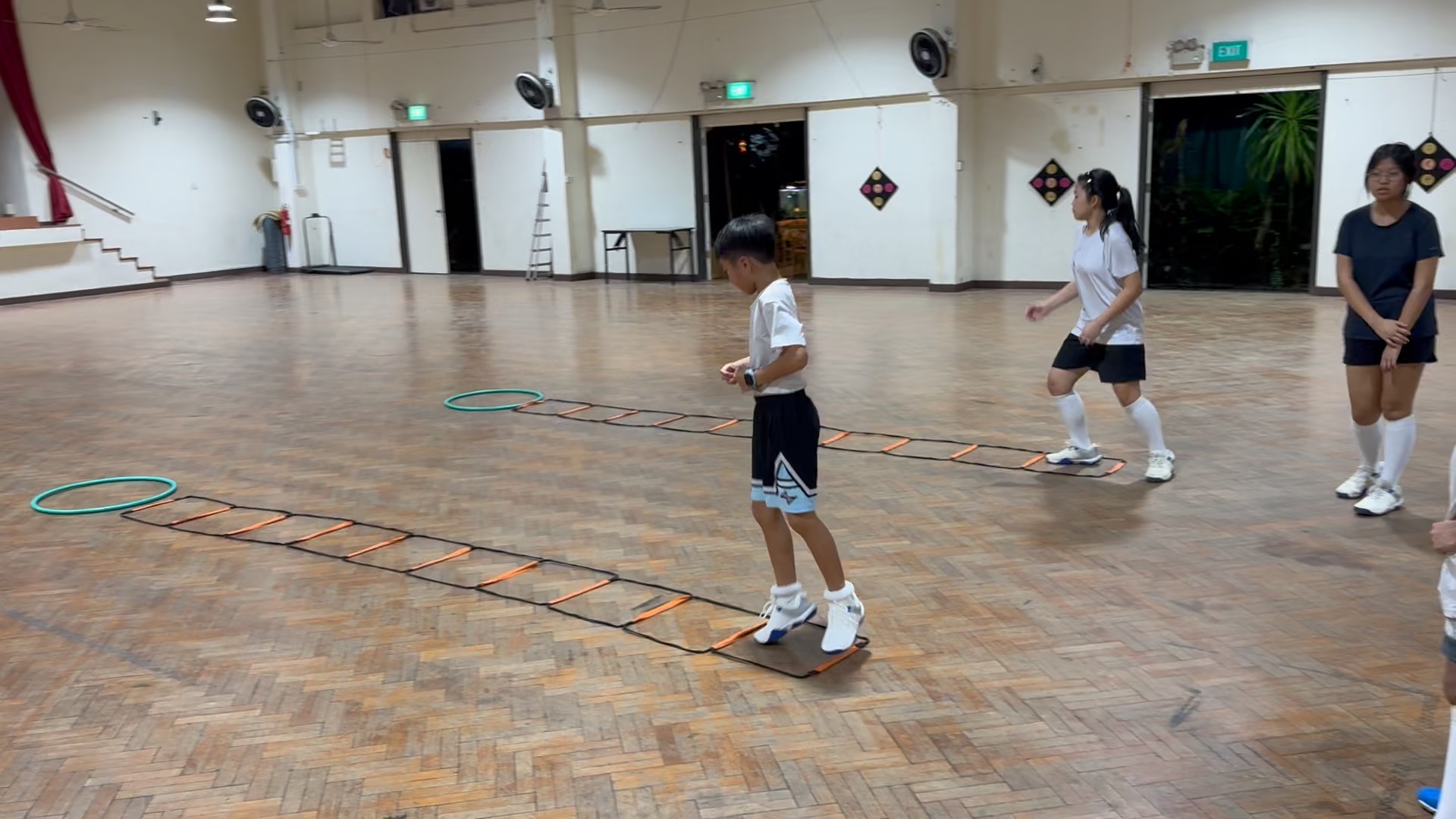
Here are the best fleche drills students practise at our epee fencing school in Singapore.
- Wall extension: Stand an arm’s length from a wall. Practise the extension and the weight shift without taking the step. Feel the fall.
- Glove drop: Have an epee fencing coach hold a glove at shoulder height. When they drop it, you must extend and fleche to catch it before it hits the floor.
- Retreat-and-release: Practise retreating three steps, then immediately launching a fleche from the back foot. This teaches you how to change direction instantly.
Here’s our training plan on how to prepare for an epee competition.
Frequently Asked Questions about fleches in fencing
How is a fleche different from a “flunge”?
A flunge (fencing lunge + fleche) is a hybrid move used primarily in sabre to replace the banned fleche. It is a leaping attack where the fencer jumps forward but does not cross their legs in the air or upon landing. In epee, a flunge is rarely used because the “running” finish of a fleche is more efficient for closing the larger distances.
Is the fleche legal in all types of fencing?
No, the fleche is only legal in epee and foil. In sabre, the fleche (and any crossover footwork) was banned in the 1990s to slow down the pace of the bouts. If you cross your back foot over your front foot in sabre, you will receive a yellow card and any touch you land will be annulled.
What happens if I run into my opponent during a fleche?
This is called corps-à-corps (body contact). In epee, jostling or making contact with unnecessary force is a penalty. However, if the contact is accidental, the referee will simply stop the bout. If you hit your opponent before the contact occurs, the touch generally stands. If the contact happens first, the touch is usually annulled.
Can I fleche if I use a French grip?
Absolutely. In fact, many pommeling fencers (holding the French grip by the very end) use the fleche to maximise their reach. A french grip fleche allows you to hit from a much further distance than a pistol grip, making it a favorite tool for defensive counter-attackers who want to surprise their opponents.
Can you fleche off the side of the strip?
If you execute a fleche and your momentum carries you off the lateral boundaries of the strip, the touch can still count as long as the hit was initiated before both feet left the strip. However, if you run off the side to avoid a riposte, the referee may penalise you for avoiding a touch.