
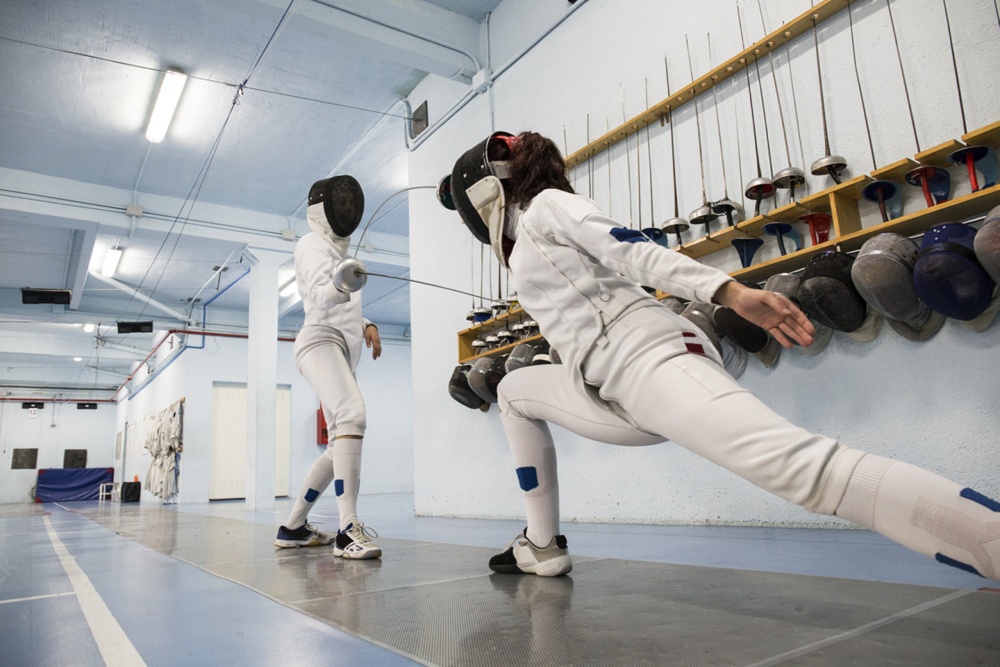
In the world of competitive fencing, epee is the ultimate test of patience and precision.
Unlike foil or sabre, the lack of right of way means the entire body is a live target. The smallest technical slip can lead to a costly double touch, while a dropped hand or lazy recovery is an open invitation for a counter-attack.
This guide breaks down the ten most common epee fencing mistakes we see in our fencing school in Singapore, together with actionable fixes to sharpen your game before your next tournament. We also included bonus videos to help visualise everything!
Whether you are a beginner struggling to find your distance or a veteran trying to break a plateau, identifying and correcting these common pitfalls is the fastest way to improve your win rate.
Technical mistakes
Success in epee begins with the blade and the body, where even a few millimeters of deviation can be the difference between a clean touch and a double.
1. Wide parries
The most common mistake for beginner epeeists is making parries that are too wide. In foil, a big parry is safer because it ensures you gain the right of way. However, in epee, a wide parry leaves your entire body exposed. If you miss the blade with a sweeping motion, your opponent can simply disengage and hit you while your hand is in the middle of nowhere.
Watch from [00:02:26] to see a bad parry where the fencer holds and pushes the blade too far, making a riposte impossible.
Solution: Focus on smaller parries. Use your wrist and fingers rather than your elbow and shoulder. Your tip should never leave the silhouette of your opponent’s torso.
2. Leading with the feet, not the hand
Many fencers begin their attack by stepping forward before extending their arm. This is called attacking in preparation. By moving your feet first, you signal your intent and bring your target (body) closer to the opponent’s tip before you have a defensive threat in front of you.
This video is a fantastic example whereby at [00:03:42], the narrator explains this error in moving your body ahead of your blade.
Solution: The extension should always start slightly before the feet move. Think of your hand “pulling” your body forward.
3. Crooked Lunge
Beginners often turn their front foot inward or let their back heel pop off the ground during a lunge. This disrupts skeletal alignment, leading to poor balance and a short lunge that is easy to parry. Worse, it puts immense strain on the medial meniscus, leading to long-term knee injuries.
Solution: Ensure your front toe points directly at your opponent. Your back foot should stay flat and perpendicular to the strip to provide a solid “anchor” for your power.
4. Dropped Guard (The “Lazy Hand”)
In epee, your bell guard is your only shield. A frequent mistake, especially when tired, is letting the hand drift downward. This exposes the top of your forearm and shoulder—targets that are much closer and easier for your opponent to hit than your torso.
Solution: Keep your hand at breast-height and slightly centered. Imagine there is a straight line from your elbow through your guard to the opponent’s chest. Never let your hand break that line of protection.
Tactical mistakes
Even a flawless extension is useless if it’s timed poorly. Once you’ve tuned your mechanics, you must address the strategic errors that allow opponents to dictate the pace of the bout.
1. Chasing the blade
In movies, fencers clank swords constantly. In epee, touching the blade unnecessarily could show that you are nervous or insecure, or worse, give your opponent the signal to attack against your rhythm.
Solution: Practise absence of the blade. Only take the blade when you have a specific intention to beat and lunge. Otherwise, keep your tip a threat to the nearest target: the hand.
2. Mismanaging the double touch
Epee is the only weapon where double touches are recorded. A common mistake is being satisfied with a double touch when you are leading. If you are up 14-13, a double touch wins you the match. But if you are trailing, a double touch is a wasted opportunity to catch up.
This video focuses on the rolled foot and improper weight distribution that lead to injuries. At [00:00:05], it shows the rolled back foot, and at [00:03:14], it provides the solution for proper toe alignment to keep the lunge stable and safe.
Solution: Change your tactics based on the score. If you are behind, you must fence for a single light, which usually requires more blade control or a deeper retreat to “pull” the opponent into a miss.
3. Static distance management
Distance is the best parry. In epee, if you aren’t moving, you are a sitting duck. Many fencers stand too still, waiting for the perfect moment to strike. Beginners often allow the opponent to dictate the distance, eventually getting trapped in a range where they can be hit without being able to react.
Seth Baldwin explains how static distance is a trap and introduces a system for making better tactical choices. At [00:05:01], he explains why parrying is actually a last resort and that the best defense is making the opponent miss with your feet (distance management).
Solution: Constant small steps. You should be in a conversation with your opponent’s feet. If they step in, you step out (or counter-attack). If they step out, you creep forward.
Equipment & psychological mistakes
Beyond the physical exchange lies the mental game, where staying composed under pressure is often the only thing separating a podium finish from an early exit.
Also, don’t let your hard work be undone by external factors—proper maintenance of your gear is the simplest yet most overlooked way to prevent phantom touches and equipment failure. Be sure to check out our fencing equipment checklist.
1. Ignoring the tip
It sounds silly, but many bouts are lost before they start.
One of the most common mistakes is failing to check your tip screws or spring tension. An epee tip must pass a 750g weight test and a shim test. If your spring is too soft, it will not pass the 750g weight test. And if it’s too stiff, your hits get harder to register.
This video gives a professional walk-through of what to look for before a bout. At [00:03:00], it explains the importance of the two tip screws and why they must be sitting properly to avoid penalties or equipment failure.
Solution: Always test your weapon on a weight and gauge before you walk onto the strip. Carry spare tip screws in your bag—they are the most common avoidable penalty in the sport.
2. Losing focus against unconventional fencers
We’ve all faced the “weird” fencer—the one who flails, jumps, or holds the sword in a strange way.
A major mistake is abandoning your own technique to match their chaotic energy. Experienced fencers often lose to beginners because they overthink the beginner’s random movements.
Solution: Keep it simple. Don’t try to read fakes that aren’t there. Stick to fundamentally sound distance and strong, single-tempo actions to the chest or hand.
3. Chasing the Score
Mental discipline is just as important as footwork. Many fencers make the mistake of panicking when they fall behind by two or three points. They start rushing their attacks and taking high-risk lunges to catch up, skipping preparation altogether. This usually just leads to being picked off by a calm opponent.
Solution: Treat every touch as if the score is 0-0. Focus on the process of the next hit rather than the math on the scoreboard. In epee, a three-point deficit can be erased in seconds, but only if you stay patient enough to find the right opening.
The Epeeist’s Checklist
Epee is a game of millimeters. One mistimed step or a wide parry is all an opponent needs to find a target.
Because the entire body is fair game, epee rewards the disciplined and punishes the careless.
To stay on the right side of the scoreboard, be sure to follow the above actionable fixes and mental checklist below to sharpen your game before your next tournament.
- Hand first: Is my arm extending before my feet move?
- Small motions: Are my parries tight and efficient?
- Active feet: Am I controlling the distance, or is my opponent?
- Target priority: Am I aiming for the nearest target (hand/arm) before committing to the body?
Frequently Asked Questions (FAQ) about common epee fencing mistakes
What are common fencing mistakes to avoid?
While each weapon (epee, foil, and sabre) has its own rules, most beginners and intermediate fencers struggle with these four universal mistakes:
- Telegraphing the attack: Moving your feet before your hand. In fencing, the tip should always lead the movement to keep your opponent from reacting too early.
- Poor distance management: Standing too close (collapsing the distance) or staying too far away. Success depends on staying just outside your opponent’s reach until you are ready to strike.
- Over-parrying: Making large, panicked movements with the blade. Efficient fencing uses small, controlled motions of the wrist and fingers to deflect an attack.
- Flat-footedness: Losing your “bounce” or staying static. Fencing requires constant, active footwork to maintain the correct timing and balance for a lunge or recovery.
Can you flick in epee?
Yes, you can. While the flick is most famous in foil, epee fencers use it to hit targets around the corner, such as the top of the wrist or the back of the shoulder. However, it is harder to pull off in epee because the blade is stiffer and the tip must be depressed with more force (750g in epee vs 500g in foil) to register a touch.
Why do I keep getting hit on the hand?
You are likely dropping your guard. In epee, your hand is the closest target. If your guard is too low or too far to the side, you leave the top of your wrist exposed. Keep your arm slightly bent and your guard centered to protect your forearm.
Should I use a French grip or a Pistol grip?
It depends on your style. Pistol grips offer more strength and control for blade takes and parries. French grips are held at the end (pommeling) for extra reach, which is great for counter-attacking styles but makes it harder to parry strongly. Most beginners should start with a pistol grip to learn proper hand position.
How do I stop flinching when an opponent attacks?
Flinching is a natural survival instinct. To overcome it, you need desensitisation drills. Have a partner practice slow, controlled lunges at you while you focus on making a small parry without moving your head or torso backward. For more drills, check out our guide to prepare for your epee fencing competition.
What is non-combativity?
This is a rule to prevent boring matches. If no touches are scored for one minute, the referee can call for a P-card. If it continues, the bout can end early. To avoid getting a P-card, score a hit to show you are active to the referee. Elite fencers typically use non-combativity as part of their strategy game.
How can I make my lunges faster?
Speed comes from the back leg and the snap of the arm. Most fencers try to step into a lunge. Instead, think of your front foot as a glider and your back leg as a pistol. Kick off with your back leg explosively while your front heel slides forward.
What is the most aggressive fencing style?
Sabre is widely considered the most aggressive fencing discipline. Because it is a “right of way” weapon where the first person to move usually gains the advantage, the bouts are incredibly fast and explosive. In Sabre, you can hit with the edge of the blade, and matches often start with both fencers sprinting toward each other the moment the referee says “Allez!”
What is the most common injury in epee fencing?
The most common injuries in fencing are strains and sprains, particularly in the ankles, knees, and hamstrings. Because of the explosive, asymmetrical nature of the lunge, fencers are also prone to:
- Lateral epicondylitis (fencer’s elbow/tennis elbow) from repetitive wrist and arm motions.
- Patellar tendonitis (Jumper’s Knee) from the heavy impact on the lead leg during a lunge.
- Blisters and bruises on the weapon hand and torso.
Join our beginner fencing classes in Singapore to learn the right techniques to avoid the above injuries!