
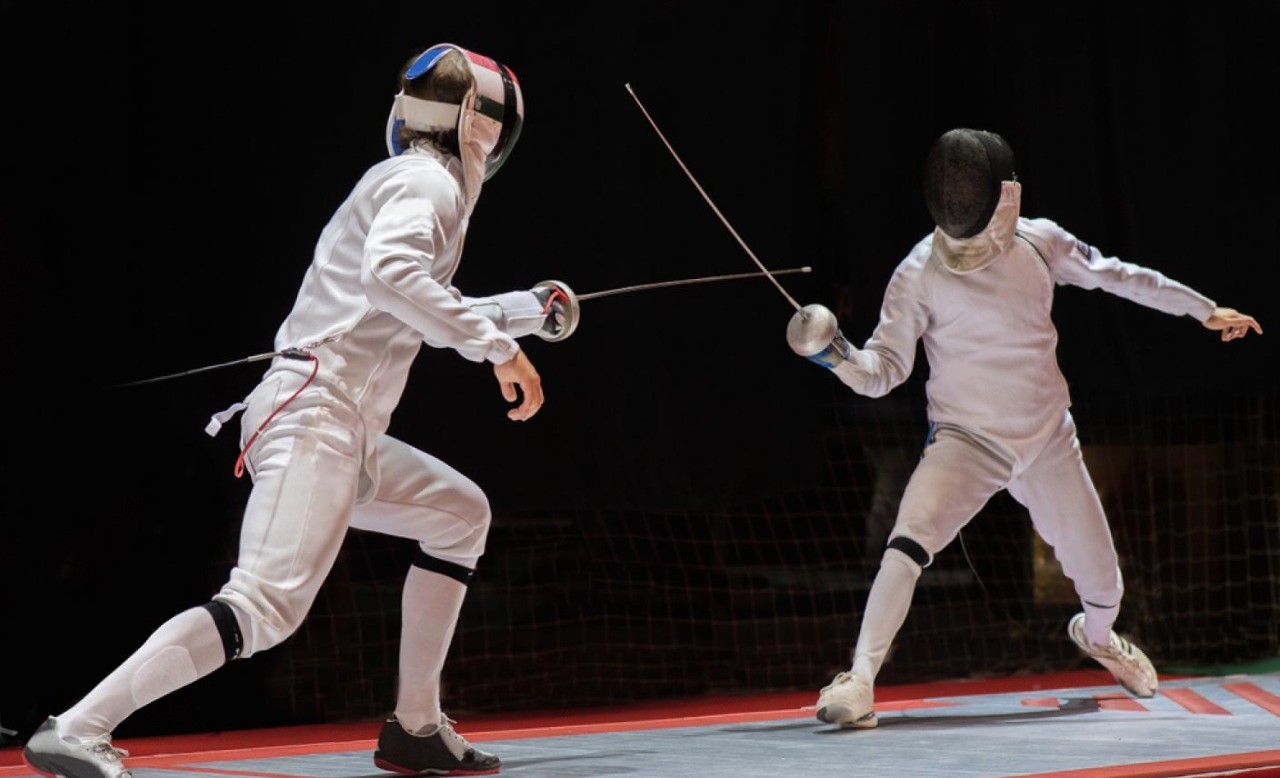
Preparation for an epee competition is as much about mental fortification and tactical planning as it is about physical conditioning. Because the entire body is a valid target in epee, the margin for error is razor-thin.
Here’s a quick summary on how to train and prepare for an epee fencing tournament based on our head coaches’ previous experience in the National Fencing Team.
The preparation process can be broken down into:
- Physical conditioning: You need a strong anaerobic (fast-twitching and explosive) and aerobic baseline to survive a long day of pools. Daily footwork is also your primary defence, so train “advance-retreat” drills while maintaining a low center of gravity. Finally, focus on fast-twitch activation through box jumps and lateral bounds to power your fleches and explosive lunges.
- Technical mastery: Practise hitting small, specific areas like the wrist, foot, and shoulder using a wall target or dummy to build pinpoint accuracy. Blade work should focus heavily on Opposition and Parries to prevent the opponent from scoring a double-hit.
- Tactical strategy: There should be a distinct game plan for different styles of opponents.
- Tournament day logistics: The day of the competition is entirely about managing your energy levels and maintaining a sharp focus.
Read on to go into detail and tips on what to do.
1. Physical conditioning
Unlike foil or sabre, epee bouts can be slow and cagey, punctuated by explosive bursts of speed. Your training should reflect this “stop-and-go” nature.
You need a baseline of aerobic fitness to survive a 15-touch bout after a long day of pools. Instead of long, slow runs, use High-Intensity Interval Training (HIIT). Sprint for 15 seconds (the length of a long exchange), then rest for 30 seconds.
Meanwhile, footwork is your primary defence. Spend 20 minutes a day on “advance-retreat” drills, focusing on maintaining a low centre of gravity.
The fleche and the explosive lunge require massive fast-twitch muscle activation. Box jumps build vertical and forward power, while lateral bounds improve your ability to change direction and maintain balance on the strip.
2. Technical mastery
In epee, the point in line and the counter-attack are king. You must be precise; hitting a toe or a wrist requires more accuracy than hitting a torso.
Set up a wall target or a dummy for target practice. Practice hitting small, specific areas:
- Wrist/Cuff: The closest target. Practice hitting this while retreating.
- Foot: Practise the deep lunge or the “sink” to hit the toe.
- Shoulder: A high-percentage target during close-quarters infighting.
As for blade work, focus on Opposition and Parries. In epee, if you hit your opponent but they hit you back within 40 milliseconds, you both get a point. To win, you must control their blade so they cannot hit you back.
3. Tactical strategy
Epee is called “physical chess” for a reason.
Distance management is the foundation of épée strategy. You should constantly vary the distance to force your opponent to attack on your terms, making them overcommit or hesitate.
You also need a deep understanding of how to read and manipulate your opponent’s reactions.
Firstly, observe their initial reactions and gut feelings (e.g., do they always counter-attack when you advance?). Use this information to set traps (second intention).
Next, focus on the actions leading up to the attack. This includes subtle footwork, feints, and blade work (beats, engages) to create an opening or confuse the opponent.
Knowing when to attack during an opponent’s vulnerable moments, such as their preparation or recovery from a lunge, is critical for successful touches.
Use the first few points (or even sacrifice a few touches in the early pool stages) to gather intelligence on your opponent’s organic reactions before fully committing to your primary strategy. This adaptation is continuous throughout the bout.
A coherent game plan provides a sense of direction and prevents panic, even when stressed. Having a clear, simple plan can help you avoid aimless movement and ensure you always know your next intended action. Here are some strategies to target different types of fencers.
| Opponent Style | Strategy |
| Aggressor: Aggressive fencers like to force the action and close the distance quickly. | Your primary goal is to disrupt their rhythm and use their momentum against them.
Use “absence of blade”: Keep your blade out of the opponent’s reach to prevent them from making blade contact (beats or binds) to initiate their attack. This forces them to commit to a long attack without control of your blade, leaving them vulnerable. Counter-attacks to the hand/arm: As the aggressor overcommits, execute a well-timed counter-attack to their extended arm or wrist. Aim to maintain arm protection with your bell guard. Parry-riposte (Second Intention): Invite the attack with subtle footwork, then execute a precise parry followed by an immediate riposte. This is a classic method for making them fall short and scoring on their recovery. Disrupt: Use early parries or beats to disrupt their preparation and discourage them from setting up their offensive actions. |
| Defender: Defensive fencers are patient, rely on distance, and wait for you to make a mistake. | The key strategy is to force Defenders out of their passive posture.
Feints (Finta): Use convincing false attacks or feints to different lines (e.g., feint high, then disengage low) to draw out a parry or counter-attack. Be ready to respond to their reaction with a second action (second intention). Varied tempo and rhythm: Disrupt their control by varying the speed of your advances and retreats. Avoid falling into a predictable pattern that allows them to time their counter-attacks. Compound attacks: Use a sequence of feints and blade actions to confuse their defensive timing and create a clear opening for the final touch. Target variation: If they protect their hand well, vary your targets to include the leg or foot, which might force them to adjust their stance and create new openings. |
| Tall fencer: They have a natural reach advantage. | The key is to neutralise the reach advantage is through distance control and angles.
Close the distance aggressively: Move in quickly with speed and agility to get inside their optimal range (infighting distance). Once in close quarters, their long arms become a liability as they need more time to retract their blade for an effective close-range hit. Target the extremities: The hand and foot are the same distance away for both fencers, regardless of height. Develop accuracy in hitting these smaller, closer targets with quick point control drills. Counter-time: Allow them to cover the distance, and as they initiate their attack, execute a planned counter-action, such as a counter-attack with opposition, to hit them before they hit you. Erratic movement: Use unpredictable, high-tempo footwork to disrupt their preferred slow and smooth tempo, forcing them to react instead of control the bout. |
Tournament nerves are real. Use visualisation for mental preparation. Spend ten minutes each night imagining yourself on the strip, hearing the referee’s “Allez!”, and successfully landing a counter-attack.
Epee fencing tournament preparation timeline
Here’s a preparation timeline for you to follow for your next fencing tournament.
4 weeks before the epee competition
Focus on maximum physical output. This is the time for your heaviest gym sessions and highest-volume sparring.
You want to push your endurance to the limit so that your baseline fitness is significantly higher than what a single day of fencing requires. Focus on high-intensity footwork drills that leave you winded.
2 weeks before the epee competition
Stop heavy weightlifting. Instead, focus on speed and your ability to execute a technical action with perfect timing and minimal telegraphing.
Take more private fencing lessons in Singapore to fine-tune your favourite actions. Don’t try to learn new moves now. Instead, pick the three actions you trust most (e.g., a counter-attack to the wrist, a beat-lunge, and a parry-riposte). Spend 80% of your sparring time perfecting the setups for these three moves.
1 week before the epee competition
Check out your epee fencing equipment list. Begin by testing all your epees with a 500g weight and 0.5mm/1.5mm gauges. If you fail the 500g weight test, replace the pressure spring. If you fail the 0.5mm gauge, replace the contact spring.
Beyond the tips, inspect your body cords and head cords using a multimeter or a test box, wiggling the wires at the plugs to catch any “intermittents”—the most common cause of a yellow card on the strip.
Finally, check your whites for any small holes or broken zippers that could fail a safety inspection, and ensure your mask’s bib and “two-strap” system (if required by your federation) are secure.
The night before your epee competition
Keep your preparation short and sweet:
- Hydrate: Drink water with electrolytes.
- Carb-load: Eat slow-burning carbohydrates like pasta or brown rice.
- Pack your bag: Don’t forget your fencing kit: mask, glove, two body cords, two head cords, and at least three working epees.
- Relax: Listen to your favourite music or watch some shows to unwind.
Fencing tournament day
The day of the competition is about managing energy and focus.
Begin your warm-up 45 minutes before. Start with a light jog, followed by dynamic stretching. Do 10 minutes of footwork and a few practice bouts to get your “eye” in.
During the pool phase, every touch counts. Even if you lose a bout, getting three or four touches helps your seeding for the Direct Elimination (DE) round.
Stay moving in between bouts. Don’t sit down for long periods as your muscles will stiffen. Be sure to snack on bananas or energy bars and drink plenty of fluids periodically.
Frequently Asked Questions (FAQ) about epee fencing tournaments
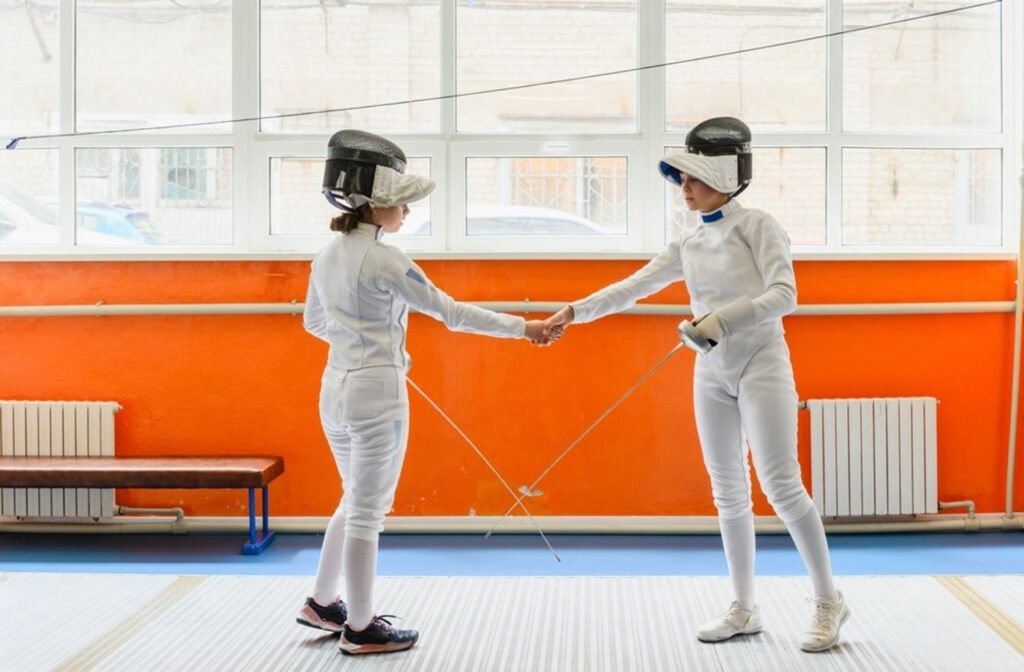
What epee competitions are there in Singapore for kids?
Singapore has a vibrant youth fencing scene with several key tournaments throughout the year, catering to different age groups (U10, U12, U14, Cadet, and Junior). Key competitions include:
- Singapore Épée Minime Fencing Challenge: Held every March and September, this is a premier local event specifically for the U10, U12, and U14 age groups. It is a fantastic entry point for young fencers to experience a high-standard competitive environment with international fencers.
- SEAFF Junior and Cadet Fencing Championships: While this is a regional Southeast Asian event, it is frequently hosted in Singapore. It brings together the best young talents in the Cadet (U17) and Junior (U20) categories.
- National School Games (NSG): For students in Primary and Secondary schools, the NSG is one of the most prestigious dates on the calendar, where fencers represent their schools in individual and team events.
- National team qualifications: Selection is performance-based, driven by the National Ranking System (NRS). Squad slots are typically awarded based on a rolling ranking system where fencers earn points from designated local and international competitions. Points are accumulated through events such as the Singapore Senior/Junior Challenges and sanctioned international tournaments.
How many epees should I bring to a competition?
You should bring a minimum of three. This allows for one primary sword and two backups in case of a blade break or a failed weight/gauge test on the strip.
What should I eat during a long tournament?
Stick to high-carb, low-fat snacks. Bananas, granola bars, and sports drinks are ideal. Avoid heavy meals that cause a sugar crash or digestive discomfort.
How do I handle double touches?
Double touches are part of the game strategy – some leading fencers actually use it to manage the game till 15 points. If you are getting too many doubles, try to take the blade (opposition) or increase your distance to force the opponent to overextend.
Is epee better for tall people?
Though height may provide a reach advantage, shorter fencers are often faster and have a smaller target area. Success in epee is more about distance management than raw height.
How do I stop my hand from cramping during my epee tournament?
Ensure you are hydrated and getting enough potassium/magnesium. Also, check your grip. If you are white-knuckling your French or Pistol grip, your hand will tire quickly. Keep your hand relaxed until the moment of the hit.