
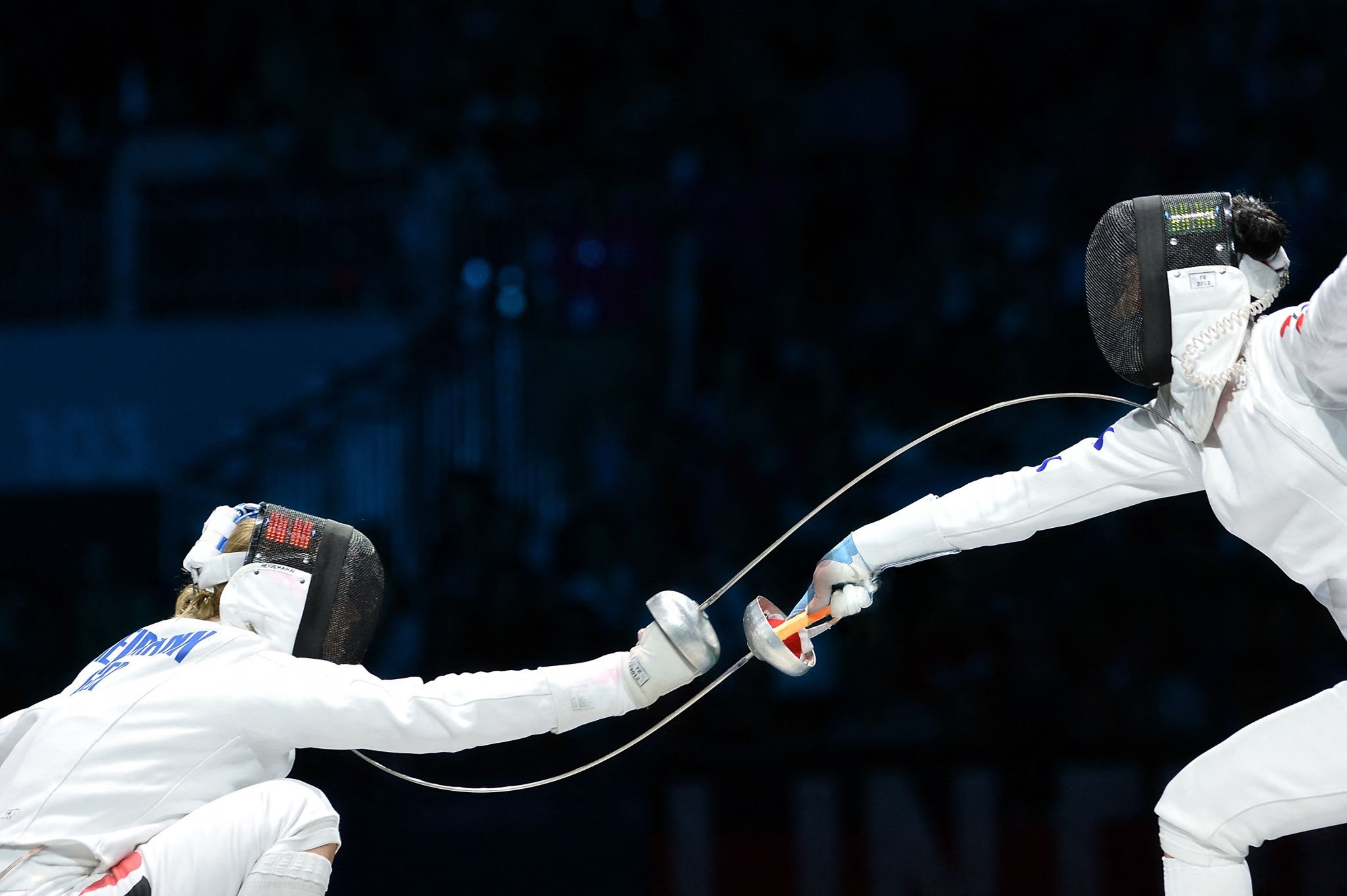
Epee is a game of pure strategy and nerves. Unlike foil or sabre, there is no “right of way” – the logic is simple: hit your opponent first, and you score the point.
Whether you are a beginner learning the nuances of distance or a veteran refining your tip control, these 26 legendary epee matches showcase the pinnacle of the sport.
These top bouts are chosen due to the fencers’ precision timing, spatial awareness, and their high-stakes decision-making that define a champion.
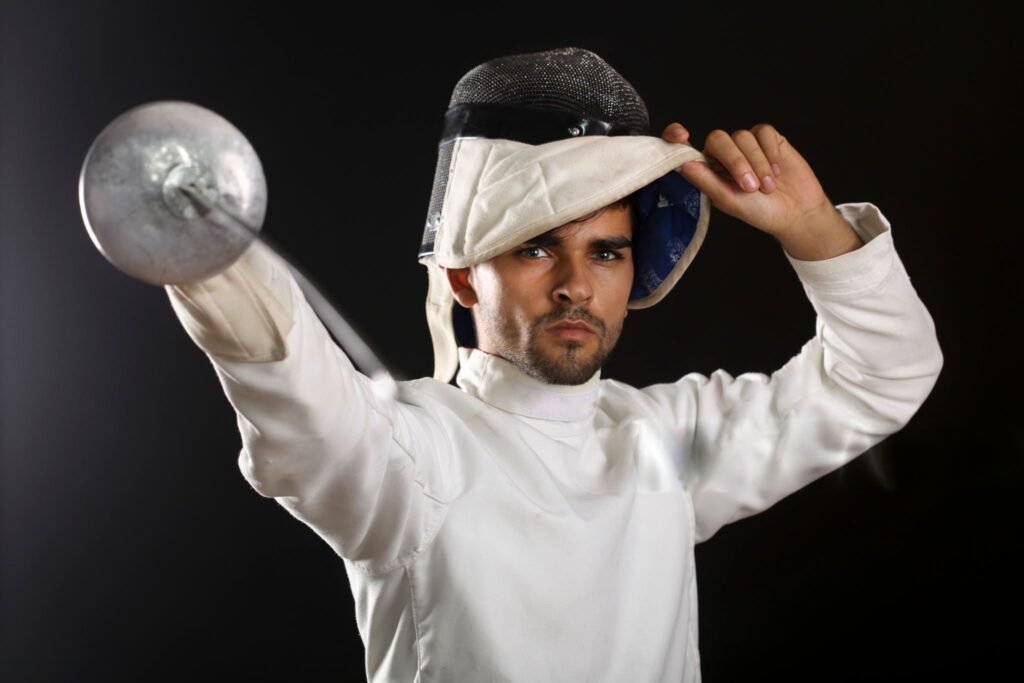
10 best men’s epee fencing bouts to watch
On the men’s circuit, the explosive element is dialed to the max. Fencers often use raw verticality and blistering fleches to bridge the distance in a fraction of a second.
The history of men’s epee is built on iconic rivalries and legendary upsets that have shaped the rules of the sport we play today.
1. Romain Cannone vs. Gergely Siklosi (2020 Tokyo Olympic Finals)
Cannone was an alternate who wasn’t supposed to fence the individual event. He used unorthodox, ducking counter-attacks to dismantle the World #1. It is truly an incredible underdog story.
2. Max Heinzer vs. Yannick Borel (2018 European Championships Finals)
This bout teaches fencers how to deal with an opponent who refuses to fence “traditionally”. Max Heinzer is known as the “Human Highlight Reel” for his unorthodox, explosive, and sometimes wild attacks. Meanwhile, Yannick Borel is the towering embodiment of the French School. Heinzer tries to create chaos to bypass Borel’s reach, while Borel remains a disciplined wall of steel.
3. Geza Imre vs. Park Sangyoung (2016 Rio Olympic Finals)
This bout is widely considered the greatest comeback in fencing history. Trailing 14–10 and needing only one double-hit to lose, 20-year-old Park Sang-young scored five unanswered touches against the reigning world champion veteran to win 15–14.
4. Gauthier Grumier vs. Ulrich Robeiri (2014 World Semi-Finals)
Two teammates who know each other’s games perfectly. This bout features insane tip control and “marksmanship”—it’s epee at its most refined and precise.
5. Ruben Limardo vs. Bartosz Piasecki (2012 London Olympic Finals)
Limardo delivers a textbook example of using the French grip offensively. He maintains a distance advantage while being incredibly aggressive, showing how to “hunt” an opponent using the grip’s extra reach.
6. Nikolai Novosjolov vs. Gauthier Grumier (2010 World Championships Finals)
This match is a masterclass in contrasting styles between two of the most dominant fencers of the 2010s. Novosjolov (Estonia) brings a physically imposing, pressure-heavy game that relies on powerful parries and timing. Grumier (France), often ranked World #1, showcases the classic French school technique: fluidity, precision, and the ability to find the smallest openings.
7. Silvio Fernandez vs. Bas Verwijlen (2011 World Cup Final)
Silvio Fernandez (Venezuela) was one of the most aggressive French-grip fencers ever to walk the strip. Unlike many French-grippers who stay defensive, Silvio hunted his opponents. If you want to see how to use the “flick” to the top of the hand or behind the back, this is the tape to study. It shows how the extra length of a French grip can be used for offensive whip-like actions that are nearly impossible to parry.
8. Fabrice Jeannet vs. Matteo Tagliariol (2008 Beijing Olympic Finals)
Jeannet’s final major stand against the up-and-coming Tagliariol. Tagliariol’s footwork in this run was so perfect that it redefined how a generation of fencers approached their distance.
9. Fabrice Jeannet vs. Pavel Kolobkov (2005 World Finals)
This is widely considered the highest level of epee ever recorded. Kolobkov (the Russian tactical genius) and Jeannet (the French athletic powerhouse) trade touches in a match that goes down to 14-14. Watch out for Kolobkov’s legendary “absence of blade” style.
10. Arnd Schmitt vs. Philippe Riboud (1988 Seoul Olympic Finals)
A vintage classic that highlights the transition of modern epee. It is slower, more deliberate, and emphasizes the deep psychological waiting game that defined fencing before the era of explosive, bouncing footwork.
10 best women’s epee fencing bouts to watch

While men’s epee bouts are often celebrated for their explosive speed and raw power, women’s epee bouts are a masterclass in tactical patience – a high-stakes game of distance control and psychological sizing up.
From legendary stalwarts who pioneered the sport to the modern-day icons who dominate the Grand Palais, here are the top ten women’s epee bouts that prove why precision always beats power.
1. Vivian Kong vs. Olena Kryvytska (2024 Paris Olympic Quarterfinals)
In this bout, you see Kong’s incredible ability to use her height and a French grip to pick off targets while retreating. It is the ultimate study for tall fencers on how to keep an aggressive opponent at bay.
2. Vivian Kong vs. Auriane Mallo-Breton (2024 Paris Olympic Finals)
In front of a roaring French crowd, Hong Kong’s Vivian Kong trailed 1-7. Her tactical pivot to stay calm and systematically pick apart Mallo-Breton is one of the greatest Olympic displays ever.
3. Sera Song vs. Alexandra Ndolo (2022 World Finals)
Korea’s Sera Song is famously fast. Watch how she uses small, rapid footwork to confuse the timing of the taller Ndolo.
4. Sun Yiwen vs. Ana Maria Popescu (2020 Tokyo Olympic Finals)
Two of the most decorated women in history. This match went to a sudden-death priority minute. Sun Yiwen’s winning touch is a clinic in timing and nerves of steel.
5. Nathalie Moellhausen vs. Lin Sheng (2019 World Finals)
Moellhausen, fencing for Brazil, used an incredibly colourful and expressive style to become the oldest first-time World Champion at age 33.
6. Mara Navarria vs. Ana Maria Popescu (2018 World Finals)
Navarria’s 2018 season was one of the most dominant in history. This match shows her aggressive, pressing style at its peak.
7. Rossella Fiamingo vs. Emese Szasz (2016 Rio Olympic Finals)
Fiamingo led early, but Szasz’s experience and ability to change her rhythm mid-bout turned the tide. A great study on mid-match adaptations.
8. Shin A-Lam vs. Britta Heidemann (2012 London Olympic Semi-Finals)
The clock froze at 0:01, allowing Heidemann to score a winning hit. Shin’s hour-long protest on the strip remains a heartbreaking but essential moment in fencing history.
9. Yana Shemyakina vs. Britta Heidemann (2012 London Olympic Finals)
This clip is a perfect study on how to fence a taller opponent. Shemyakina (the shorter fencer) used her French grip and superior hand-picks to neutralise the physical advantages of Heidemann.
10. Laura Flessel vs. Valerie Barlois (1996 Atlanta Olympic Finals)
This was the first-ever Women’s Olympic Epee final. Flessel, known as “The Wasp” (La Guêpe), used her trademark foot-hit to secure the historic gold.
6 best team fencing bouts to watch
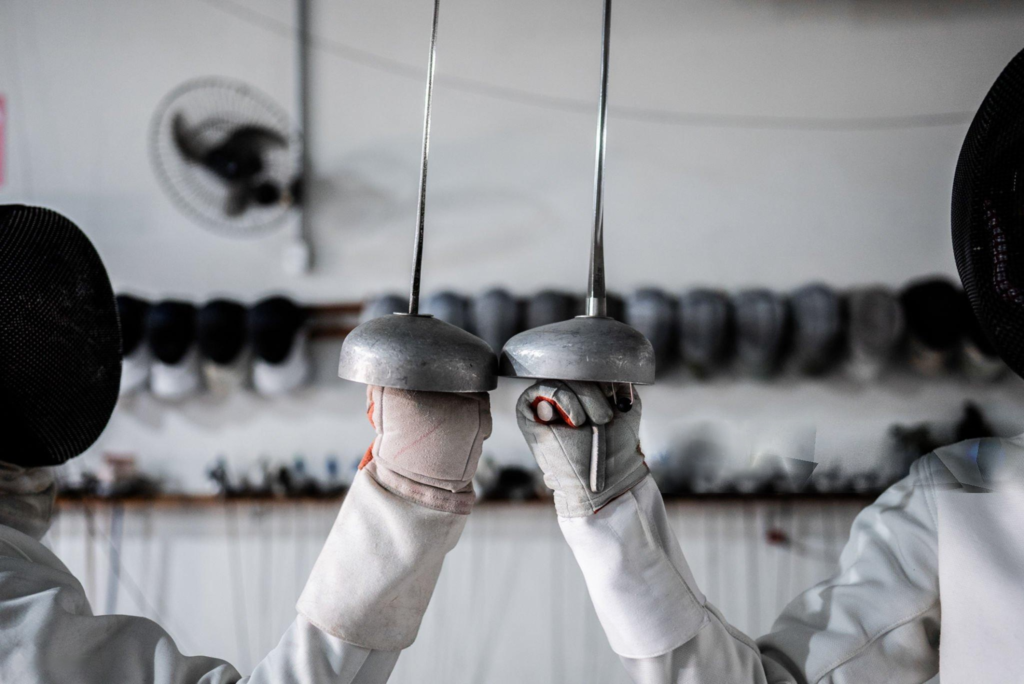
While individual bouts are about personal glory, team matches are about the “relay” strategy—where every touch carries over and the first to 45 wins.
1. Singapore vs. Vietnam (2025 SEA Games Finals)
Trailing 5-10 early, Singapore’s men’s epee team, led by Simon Lee and Azfar Ong, two of the Team Singapore fencers to watch out for, mounted a massive comeback to win 44-34. This match is a fantastic study for club fencers on how to narrow the deficit when you’re down by 5 or more touches early in the relay.
2. Japan vs. France (2020 Tokyo Olympic Finals)
Japan had never won an Olympic gold in fencing until this moment. Watch Kano (much shorter) use explosive speed to hold off the reach of the 6’5″ Borel.
3. South Korea vs. China (2020 Tokyo Olympic Bronze Medal Match)
A tactical grind between two of the world’s most disciplined teams. It was tied 34-34 going into the final round. Individual gold medalist Park Sangyoung stepped up as the anchor and delivered 11 touches to win 45-42. It’s a perfect example of how an individual champion translates their skills to a team environment.
4. USA vs. France (2012 World Team Final)
This is the gold standard for team epee. The US team faced a French team that had won every single World or Olympic team event from 2004 to 2011. Kelsey, Thompson, Bratton, and Pryor dismantled that dynasty. This match provided massive validation for the US and is a masterclass in team relay strategy. Watch the final leg for a masterclass in “closing” against a legendary opponent.
5. USA vs. Russia (2012 London Olympic Bronze Medal Team Match)
This was a grueling match that came down to the final seconds. It entered the final leg (the 9th bout) with the score tied. Courtney Hurley, serving as the anchor, faced off against Russia’s Anna Sivkova. In a high-stakes overtime period, Courtney finally scored the decisive sudden-death touch to win 31-30.
6. Italy vs. France (2000 Sydney Team Final)
This match is famous for its intensity and the legendary players involved like Hugues Obry and Angelo Mazzoni. It ended in a 44-43 heartbreaker. It is widely cited as the reason for modern rule changes regarding athlete behavior and safety—after the final touch, the emotional explosion was so great that it changed international fencing forever.
Frequently Asked Questions About Epee Fencing Bouts & Matches
How are individual epee fencing bouts scored?
In individual epee, bouts are scored by touches—landing the tip of the blade anywhere on the opponent’s body (including feet and mask). Unlike foil or sabre, if both fencers hit within 0.04 seconds of each other, both receive a point.
In standard bouts, the first fencer to reach 15 touches wins. If the score is tied when time expires, fencers compete for one final minute. One fencer is randomly assigned “priority”; if no hit is made in that minute, the fencer with priority wins.
How long does an epee fencing bout last?
A bout consists of three periods of 3 minutes, with 1-minute breaks between them. The bout ends immediately if a fencer reaches 15 touches before the 9 minutes are up.
What’s the difference between a fencing bout, match, pool & tournament?
A bout is a single head-to-head contest between two fencers.
In individual fencing, a match is often used interchangeably with “bout.” In team fencing, however, a match refers to the entire set of 9 bouts between two opposing teams.
Pools refer to the preliminary round-robin phase. Fencers are divided into small groups to fight short, 5-point bouts. Results here determine your “seeding” (ranking) for the next round.
Direct Elimination (DE) is the knockout phase. Using the rankings from pools, fencers compete in 15-point bouts (for epee and foil) where the loser is eliminated from the tournament.
A tournament is the entire organised event, usually consisting of a round of Pools followed by a Direct Elimination bracket.
Here’s a summary of their differences:
| Format | Max Points | Rounds/Bouts | Time Limit |
| Individual (Direct Elimination) | 15 | 3 rounds | 9 minutes total |
| Individual (Pool) | 5 | 1 round | 3 minutes |
| Team (Relay) | 45 | 9 bouts | 3 minutes per bout |
How does team fencing scoring work?
Team matches involve nine bouts where the scores carry over. Each of the three fencers on a team faces all three on the opposing team. The goal is to reach a total of 45 points.
What is the “Anchor” in team fencing?
The “Anchor” is the fencer who competes in the final (9th) bout. They carry the heaviest pressure because they are responsible for closing out the match. Legendary anchors like Seth Kelsey or Koki Kano are famous for their ability to stay calm when the score is tied at 40-40.
Who is considered the best fencer of all time?
Statistically, Mangiarotti is the most successful fencer in history. Competing between 1936 and 1960, he earned 13 Olympic medals (6 gold, 5 silver, 2 bronze) and 13 World Championship titles. He was a master of both the Foil and Épée.
In the modern era, these are the fencers who dominated highly specialised fields:
- Valentina Vezzali (Italy): Widely considered the greatest female fencer of all time. She won six Olympic gold medals in Foil and 16 World Championship titles. She is the first fencer in Olympic history to win the individual Foil gold at three consecutive Games.
- Pavel Kolobkov (Russia): A dominant force in Men’s Épée, Kolobkov won six Olympic medals across five different Olympic Games and achieved six World Championship titles.
- Laura Flessel-Colovic (France): Known as “The Wasp” for her surgical precision, she is France’s most decorated female Olympian, holding five Olympic medals in Women’s Épée.
- Aron Szilagyi (Hungary): The modern king of Sabre. He made history by winning three consecutive Olympic individual gold medals (2012, 2016, and 2021), a feat rarely seen in any combat sport.
How do you find fencing bouts online?
- CyrusofChaos (YouTube): The premier archive for raw tournament footage and high-level analysis.
- FIE Fencing Channel: For official, high-definition Olympic and World Championship replays.
- USA Fencing: The best source for domestic North American Cups (NACs).
Why should you watch top fencing bouts instead of just practicing?
As fencing analyst Igor Chirashnya notes, watching is a form of mental training. However, don’t just “watch”—study. Pause the video, look at the distance between the fencers, and try to predict the hit. If you are confused by an action, write it down and show it to your coach.
What is the hardest discipline in fencing?
It ultimately depends on your natural strengths, as each weapon poses a different challenge.
For example, foil is often considered the hardest to start because of its strict rules.
- Difficulty: Mastering the “Right of Way” (rules of priority) and hit a tiny target area (the torso) using only the tip of the blade.
- Best for: Detail-oriented individuals who enjoy technical precision.
Meanwhile, epee is the hardest mentally because it requires extreme patience.
- Difficulty: The entire body is a target. One small mistake—like a lazy hand or foot—results in an immediate point for the opponent. There are no rules of priority to protect you.
- Best for: Analytical thinkers and patient “problem solvers.”
Lastly, sabre is the hardest physically due to its explosive pace.
- Difficulty: Bouts are decided in milliseconds. You can score with the edge of the blade, making it incredibly fast-paced and requiring near-instant reflexes.
- Best for: High-energy kids with fast reaction times.